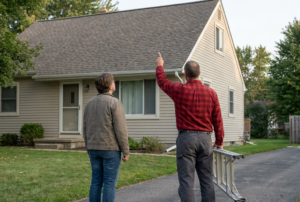
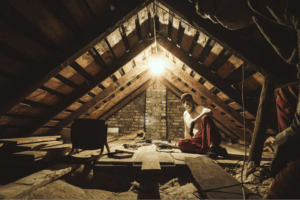
Chimney Flashing Repair: Why It Fails in Michigan and What a Real Fix Involves
Have a question about this topic?
Have a question about this topic?
Ask Roofster — our AI roofing expert is available 24/7.
Ask Roofster — our AI roofing expert is available 24/7.
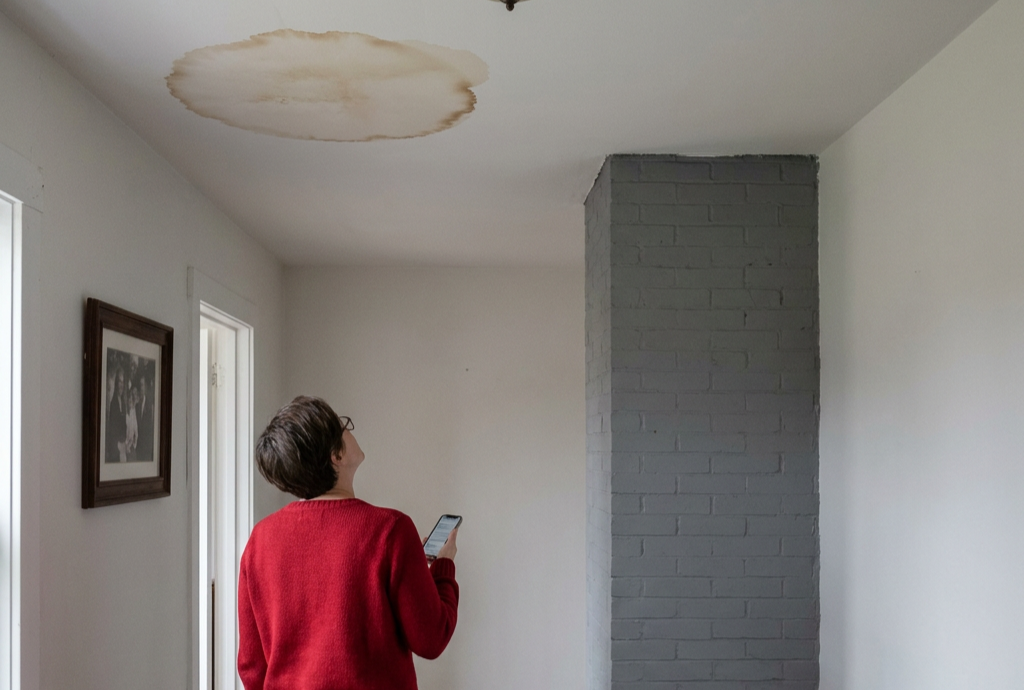
“They told me my chimney flashing is bad. What does that actually mean?”
It usually arrives with a phone photo of a ceiling stain and a quote nobody can read. Flashing is not one thing: three pieces of metal do three different jobs where the chimney meets the roof, and which one failed changes the repair, the price, and which trade the work belongs to.
Your Chimney Has Three Pieces of Flashing, and Each One Fails Differently
Step flashing is a series of small L-shaped pieces, one per shingle course (a horizontal row of shingles), woven in as the roof was installed so each piece laps the one below, running up both sides of the chimney.
Base flashing, or apron flashing, is the wider piece across the low side where the chimney meets the slope.
Counter flashing is the outer layer, set into a reglet (a groove cut into a mortar joint, the line of mortar between two rows of brick) and bent down over the step flashing. It catches water running down the brick face and drops it outside the step flashing, not behind it.
Wide chimneys also need a cricket, or saddle: a small peaked structure behind the chimney that splits water and snow around it instead of letting it pond.
Key takeaway: Ask which piece is being repaired. The three fail and price differently.
Michigan Winters Work on Flashing 20 to 30 Times Every Season
Mid-Michigan runs through roughly 20 to 30 freeze-thaw cycles in a typical winter. Water finds a hairline gap at a flashing joint or in the mortar and freezes overnight. Ice takes up about nine percent more room than water, levering the gap a fraction wider. It thaws, more water runs in, and freezes again. Twenty or thirty repetitions turn a gap too small to see in October into an opening by March.
The same cycle goes after the mortar joint holding the counter flashing. Mortar is porous and spalls (crumbles at the surface) with repeated freezing, and once the joint deteriorates, the metal set into it has nothing anchoring it. That is why counter flashing usually pulls loose years before it rusts through. Masonry design guidance treats water at these joints as a detailing problem, and replacing failing flashing before winter is ordinary fall maintenance here.
Key takeaway: Flashing rarely fails from one bad storm. It fails from a winter of small ones.
The Water Stain Usually Shows Up Somewhere Other Than the Chimney
Water that gets past the flashing lands on the roof deck (the plywood or board sheathing under the shingles) and runs along it, or down a rafter, until it finds a seam. The stain can land several feet away, on a different wall, or a floor below. Look for:
- Rust streaking on the shingles below the chimney
- A gap at the top edge of the counter flashing, or metal that moves when pressed
- Mortar missing or crumbling from the joint the flashing sits in
- Staining on the attic deck or rafters, before any ceiling stain
- A drip that appears only in driving rain from one direction
Not every chimney moisture problem is flashing. Condensation inside the chimney leaves damp and staining too, with a different fix.
Key takeaway: A stain several feet from the chimney does not rule the chimney out.
Sealant Buys a Season Because It Cannot Do the Two Things Flashing Does Mechanically
A bead of sealant along a flashing joint is a legitimate repair, and in November with water running down a wall it is often the right call. It is a temporary one: sealant is flexible, has a finite fatigue life, and sits in the path of every freeze-thaw cycle between two materials that move at different rates.
What it cannot do is either mechanical job. Step flashing is woven into the shingle courses, so water always lands on top of a lap. Counter flashing is anchored in a cut in the mortar, directing water on the brick face out over the step flashing. Both are assembly, and a bead on the surface restores neither lap, which is what building enclosure specialists find with surface-mounted counter flashing.
A proper repair is assembly work: cut the old mortar joint back, set the counter flashing into a fresh reglet, repoint the joint (tuckpointing, or refilling the mortar), and weave new step flashing into the shingle courses.
Key takeaway: Caulk seals a gap; flashing directs water. A sealed joint tends to reopen in one winter.
Chimney Flashing Repair Costs Less During a Roof Replacement Than as a Separate Trip
Nobody prices this from a photo, but what moves the number is predictable: chimney size and height, roof pitch and the staging a steep roof requires, how much mortar joint has to be cut back and repointed, and whether the step flashing comes out with the shingles. Galvanized steel, aluminum, and copper do not price alike.
Timing moves it most: flashing replaced while a roof is already torn off costs far less than the same work as a standalone call, because the shingles are up and the crew is staged. The broader repair-versus-replacement math lands the same way.
It runs the other way too: flashing should be replaced during a roof replacement, never reused. Old flashing under new shingles is a common reason a brand-new roof leaks at the chimney in year two, so ask any quote whether new flashing is included, alongside what roof repairs run in Michigan.
Weather Vane Roofing’s $1,000 Repair Credit Guarantee applies: if the roof needs replacing within a year of a repair, that repair cost comes off the install, up to $1,000. Flashing repairs carry up to a 10-year workmanship guarantee.
Key takeaway: The cheapest time to replace chimney flashing is while the roof is already open.
Which Component Failed Decides Whether You Need a Roofer or a Chimney Specialist
Flashing is a roofing assembly: woven into the shingles, fastened to the deck, repaired by working in the roof covering. Damage higher up is chimney work — a cracked crown (the sloped concrete slab across the top), a missing cap, a deteriorated flue liner. Weather Vane Roofing does both, so you do not have to make that call yourself. An inspection sorts it, and knowing what a roof inspection covers makes the conversation shorter. If the chimney is also due for a sweep, book the two together.
What to Do With a Stain and a Quote
October is the last comfortable stretch for this work in Mid-Michigan; mortar work gets harder in the cold. If you are holding a quote, the most useful next step is getting someone on the roof to name the part: step, base, counter, or the mortar joint underneath it. Once the piece has a name, the scope reads plainly, and so does the price.
Schedule a Free Inspection
A chimney leak is a diagnosis problem before it is a pricing problem. Weather Vane Roofing inspects roofs and chimneys across Mid-Michigan from Lansing and Owosso, and the inspection names the component that failed. Schedule a free inspection, or ask Roofster if you would rather start with a question.