Do You Need a Chimney Cap? Benefits, Costs & Installation
Have a question about this topic?
Have a question about this topic?
Ask Roofster — our AI roofing expert is available 24/7.
Ask Roofster — our AI roofing expert is available 24/7.
Three parts sit at the top of a chimney, and homeowners routinely pay to replace the wrong one. The cap covers the flue, the open shaft smoke travels up. The crown is the sloped concrete slab around it. A prefabricated chimney — the framed, sided box on many Michigan homes built since the 1980s — has no crown, but a chase cover: a sheet-metal pan flashed into the roof.
A chimney cap is not required for a chimney to function, which is why so many Michigan homes have never had one. An uncapped flue is an open hole in your roof, and a cap is among the least expensive parts on the roof to replace. Which part you have, and which one is failing, decides everything that follows.
Most Michigan Chimney Leaks Start at the Crown or the Chase Cover
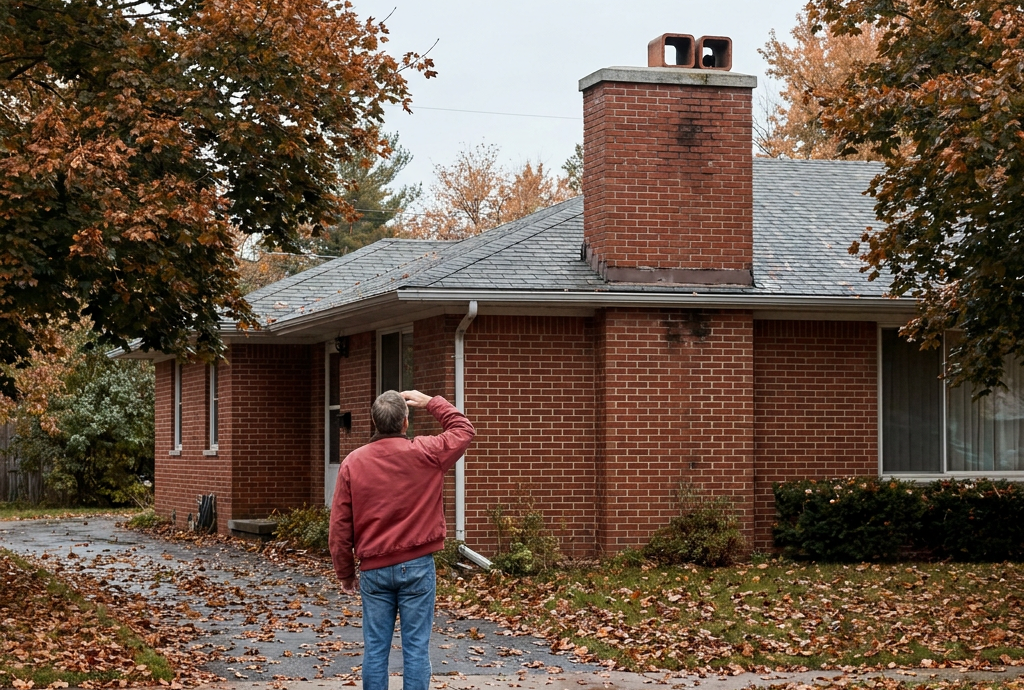
On a masonry chimney, the lighter band of concrete at the top is the crown, poured to shed water off the brick. Michigan’s 20 to 30 freeze-thaw cycles a winter work every hairline crack in it wider each year. Crown failure shows as dark staining down the brick, spalling (brick faces flaking off), or gaps around the flue tile.
The cap is the metal hood over the flue opening, usually a lid on legs with mesh screening between them. Its failures are the easiest to spot: gone after a windstorm, mesh torn open, or a galvanized cap streaking orange rust down the brick below. A stock cap covers one flue; two or more flue openings under a single crown, commonly a fireplace and a furnace, need one larger cap fabricated to span them.
A prefab chimney shows siding instead of brick, and instead of a crown a flat metal pan with the flue pipe coming through it. That pan is the chase cover, often thirty-year-old galvanized steel that has been holding standing water. Rust streaking down the siding is the signature, as is a pan sagged into a shallow dish.
Key takeaway: Cap, crown, and chase cover fail differently. Identify which one you have before anyone quotes you.
Water Past the Flue Ends Up in Your Roof Deck
Rain and snowmelt entering an open flue run down the flue liner, the clay or metal sleeve inside the chimney, pooling on the smoke shelf and rusting the damper shut. Water absorbed into masonry in November freezes in January and expands, turning a hairline crown crack into a broken crown in two or three seasons. On a prefab chimney the path is shorter: past a rusted chase cover, water reaches the wood-framed chase that penetrates the roof deck, the plywood your shingles are nailed to, then the attic below.
Chimney flashing, the metal sealing the joint where the chimney meets the roof, is the other common source of a chimney leak and is worth replacing before winter if it is loose. Water appearing inside a cool flue with no rain is usually condensation rather than intrusion.
The mesh does a second job as a spark arrestor, catching embers before they reach your shingles; NFPA 211 sets those openings between 3/8 and 1/2 inch, small enough to stop an ember and large enough not to clog with soot. A cap also cuts downdraft, wind pushing back down the chimney and sending smoke and cold air into the room.
Key takeaway: An uncapped flue routes water into the masonry, the damper, and on a prefab chimney the roof deck.
October Is When Michigan Wildlife Goes Looking for Your Chimney
Raccoons and squirrels start hunting a dry winter den in the fall, and an uncapped flue is the best one on the block: vertical, sheltered, warm at the bottom. Birds arrive in spring and build nests that block the flue, a draft problem and a fire risk at once. Leaves and twigs settle on the smoke shelf and stay wet.
The trees that drop the most debris on Michigan roofs drop it into an open flue as readily as into a gutter, and lake-effect snow melts on a warm chimney and refreezes at the crown overnight. Intact mesh stops the animals and most of the debris.
Key takeaway: Fall is when Michigan chimneys collect animals and debris, and mesh screening stops both.
Most of the Bill Is Safe Access, Not the Cap
What drives the price: flue count, cap size, material, whether an old cap comes off first, chimney height and roof pitch, whether the crown or chase cover is failing too, and the season. Labor is a large share, and most of it is safe access to the top of a chimney.
A better cap barely moves the total, because the expensive half of the work is identical either way. Galvanized typically lasts three to five years in Michigan before rust starts, against ten to twenty-five or more for stainless. A rusting galvanized cap also stains the brick below it on the way out.
The boundary on doing it yourself is height and fabrication. A stock single-flue cap on a low, walkable masonry chimney is a real DIY job, and the prefab cap on the shelf at Menards or Home Depot is fine for it. It stops at multi-flue caps, any chase cover (sheet-metal fabrication flashed into a roof), steep or tall roofs, and a cracked crown. Before the climb, what not to do on your own roof is worth five minutes.
Key takeaway: Access drives the cost, which is why buying the better cap costs almost nothing extra.
The Cheapest Install Happens While Someone Is Already Up There
Chimney cap installation is rarely worth a trip of its own. The access is already paid for when a crew is on your roof for a replacement, gutter work, or a fall inspection. Pairing chimney work with a roof inspection is the same logic applied to sweeping.
Caps, crowns, chase covers, and the flashing around them are roof work. Flue liners, draft diagnosis, and creosote belong to a CSIA-certified chimney sweep, and we say so when that is the answer.
A cap or chase-cover install carries up to a 10-year workmanship guarantee, and if a replacement follows within the year, the $1,000 Repair Credit Guarantee applies to it like any other repair.
Key takeaway: Cap work costs least riding along with a visit already on the calendar.
Start From the Driveway
Look at the top of your own chimney from the street. Brick with a lighter concrete band is a masonry chimney with a crown; siding with a metal pan on top is a prefab chimney with a chase cover. A metal hood over the flue opening means you have a cap, and an open clay tile means you don’t. Most homeowners who do this once can tell a crown from a chase cover for as long as they own the house.
Schedule an Inspection
If you cannot tell which part is up there, or which one is failing, an inspection answers it without you leaving the ground. Weather Vane Roofing crews are on Mid-Michigan roofs through the fall for exactly this, from Lansing and Owosso out to Howell and Brighton. Here is what an inspection covers. If you would rather describe what you are seeing, Roofster can take the question any time.