How Much Does Attic Insulation Cost in Michigan?
Have a question about this topic?
Have a question about this topic?
Ask Roofster — our AI roofing expert is available 24/7.
Ask Roofster — our AI roofing expert is available 24/7.
Most people start this question by looking up a price per square foot. Plenty of Michigan sources publish one, and they disagree with each other by more than three times on the same material. One page’s top end for blown-in cellulose sits above another page’s bottom end for spray foam.
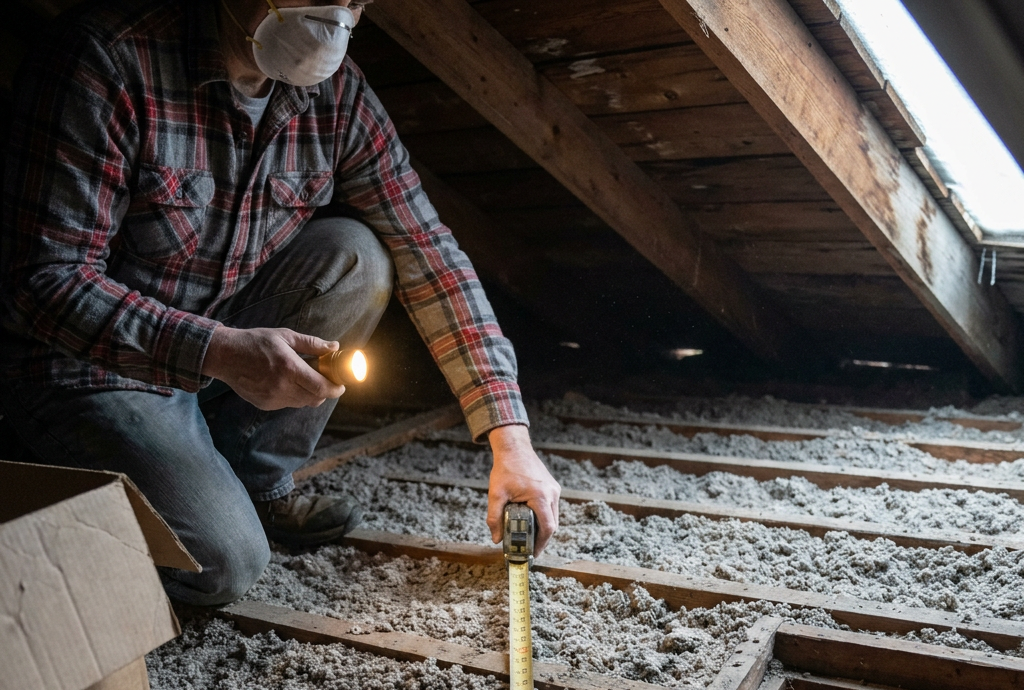
What can be pinned down is what decides the bill: how far your attic sits from where it should be, how many inches close that distance, and what has to happen first. All three are knowable in five minutes with a tape measure and a flashlight. Some homeowners go up, find twelve good inches of dry insulation and clear vents, and do not need this job at all.
Your Attic’s Depth Decides This, Not a Price List
R-value measures how well a material resists heat flow, and on an attic floor it comes almost entirely from depth.
Michigan’s adopted energy code, the 2015 Michigan Residential Code, sets ceiling insulation at R-38 in Climate Zone 5A, which covers Mid-Michigan. It governs new construction and major renovation, not the house you are standing in.
The Department of Energy and ENERGY STAR recommend R-49 to R-60 for attics in Climate Zone 5, R-60 for bare joists and R-49 where several inches are already down. Code is a floor; the recommendation is where the payback sits, and a contractor offering to bring you up to code is quoting the lower number.
The rest is arithmetic. Blown-in cellulose, recycled paper fiber blown loose across the attic floor, runs about R-3.2 to R-3.8 per inch, so at roughly R-3.5, 11 inches reaches R-38, 14 inches reaches R-49 and 17 inches reaches R-60. Blown fiberglass delivers less per inch, closer to R-2.2 to R-2.9.
Cold rooms upstairs, uneven snowmelt and a furnace that never shuts off say the same thing depth does about whether the insulation you have is still working.
Key takeaway: Code asks for R-38 here; the Department of Energy recommends R-49 to R-60. The distance between your depth and that recommendation is what you are buying.
Blown-In Cellulose Closes Most Michigan Attic Gaps for the Least Money
For an open attic floor you can walk across, blown-in attic insulation is the default, and cellulose is usually the least expensive installed option. It works around framing and goes down over what is already there.
| Material | What it is | Where it fits |
|---|---|---|
| Blown-in cellulose | Loose recycled paper fiber | The default for most Michigan attic floors |
| Blown-in fiberglass | Spun glass fiber, blown loose | Open floors; more depth per R-value |
| Fiberglass batts | Pre-cut rolls laid between joists | Even joist spacing, nothing in the way |
| Spray foam | Liquid foam that expands and hardens | Roof deck, slopes, finished attic space |
Spray foam costs the most per square foot by a wide margin, which is why it belongs on a roof deck or in a finished attic, not a flat, open floor.
Four things add work before insulation goes down, and they move the bill more than the material does.
- Removing old insulation that is wet, rodent-damaged or matted flat.
- Air sealing, closing the gaps where heated air leaks into the attic at the top plate where walls meet the ceiling, around the hatch and at light fixtures. Insulating over unsealed leaks buys less.
- Access. A pull-down stair over a walkable floor is quick to work in; a tight closet hatch is not.
- Knob-and-tube wiring in pre-1950 homes. The old cloth-sheathed wiring cannot be buried, so clearance work and a vapor barrier, the sheet that keeps household moisture out of the insulation, come first — the largest of the four, and the likeliest to surprise an older-home owner.
Blowing cellulose across an open floor is genuinely DIY-able with a rented machine and a helper. Air sealing the top plate, setting baffles (the rigid channels that stop loose insulation choking the soffit vents at the eaves), and anything touching knob-and-tube are not.
Key takeaway: Material choice matters less to the final number than what has to happen before the material goes down.
The Money Available in Michigan This Year Is Local, Not Federal
The federal Section 25C tax credit for insulation is gone. The One Big Beautiful Bill Act terminated it for property placed in service after December 31, 2025, so a 2026 attic project does not qualify. ENERGY STAR’s federal tax credit page carries the status as of late 2026.
The local programs are real.
Consumers Energy pays an attic insulation rebate tiered by the R-value you install:
| Installed R-value | Gas or combo customer | Electric-only customer |
|---|---|---|
| R-48 or less | $125 | $50 |
| R-49 to R-59 | $175 | $60 |
| R-60 or higher | $200 | $70 |
A minimum of 500 square feet applies, and applications must be received by December 31 to qualify at the advertised levels. The tiering is the argument: the utility pays more to go past code, and more again to reach R-60.
Lansing Board of Water & Light runs its own 2026 insulation and air-sealing rebate for electric customers with central air or electric heat, minimum installed R-20, while funds last. Amounts change, so check the current BWL program page.
MiHER, Michigan’s Home Energy Rebates program run by EGLE, covers up to $1,600 for insulation and air sealing at or below 80% of area median income, and half that between 80% and 150%. New income-qualified applications in EGLE’s Lansing district are paused while the program reviews funding capacity, so check the program page first.
Key takeaway: Consumers Energy pays more the higher the R-value you install, which is the clearest signal that going past code minimum is where the return sits.
The Cheapest Attic Access You Will Ever Get Is a Roof That Is Already Open
Three things change when a Michigan attic gets to R-49 or better.
Heating bills drop. ENERGY STAR puts the average saving from air sealing plus insulation at roughly 15% of heating and cooling costs, and a Michigan heating season is long enough that the same inches return more here than they would in a mild climate.
Ice dams get less likely. Heat escaping through the ceiling warms the roof deck, melts snow from underneath, and the meltwater refreezes at the cold eave into a ridge that backs water up under the shingles. Insulation and ventilation are the fix; heat tape treats a roof that already dams.
And the cold upstairs bedroom usually stops being cold.
Insulation only pays off if the attic still breathes. Burying the soffit vents under blown-in trades a heating bill for attic condensation and soft sheathing, which is why baffles go in first and why ventilation has to come with insulation.
Insulation, ventilation and the roof deck are one assembly, and a tear-off is the one moment all three are reachable at once. Weather Vane Roofing installs roofing and insulation both, so we will say plainly: insulating in March and re-roofing in September pays for attic access twice. If a replacement is already on your horizon, what that costs in Michigan is the better place to start.
Key takeaway: The heating bill, the ice dams and the cold bedroom all come off the same fix.
Go Up There With a Tape Measure First
Push a ruler down to the drywall in three or four spots and read the shallowest number. Under eleven inches is a real gap worth pricing. Eleven to fourteen puts you at or just past code and short of the recommendation, a top-up rather than a full job. Over fourteen, with dry material and clear vents, you are fine. Ask every bid to state the material, installed R-value and square footage in writing, the same way a thorough roofing estimate spells out its scope, and the quotes become numbers you can check.
Have Someone Read the Whole Assembly
If your attic measures short and you would rather have someone look over the insulation, the soffits and the roof deck in one visit, Weather Vane Roofing does free assessments across Lansing, Owosso, Howell and Brighton. If that visit turns up a roof repair, the $1,000 Repair Credit Guarantee applies its cost toward a replacement within the year. And if you only want to know what R-value you have, Roofster can answer that without a truck coming out.