Hail Damage vs. Normal Wear: How to Tell the Difference on Your Roof
Have a question about this topic?
Have a question about this topic?
Ask Roofster — our AI roofing expert is available 24/7.
Ask Roofster — our AI roofing expert is available 24/7.
Your neighbor got a new roof after the same storm that hit your house. The adjuster looked at your shingles and said it was just wear and tear. Now you’re standing in your yard wondering whether they missed something or whether your neighbor got lucky.
This is one of the most common calls we get during storm season in Mid-Michigan. A homeowner isn’t sure what they’re looking at, and the stakes feel high either way. File a claim on normal wear, and it goes on your CLUE report even if it’s denied. Ignore real hail damage, and a small problem turns into a big repair by next spring.
The difference between hail damage and normal aging is specific and identifiable. Knowing what to look for puts you in control of the conversation with your adjuster, your contractor, and your insurance company.
What Hail Damage Actually Looks Like on Shingles
Hail hits are random. That’s the single most important visual clue. When hailstones strike a roof, they land in no predictable pattern. The dents vary in size depending on the hailstone, and they show up across the entire roof surface without following lines, seams, or walkways.
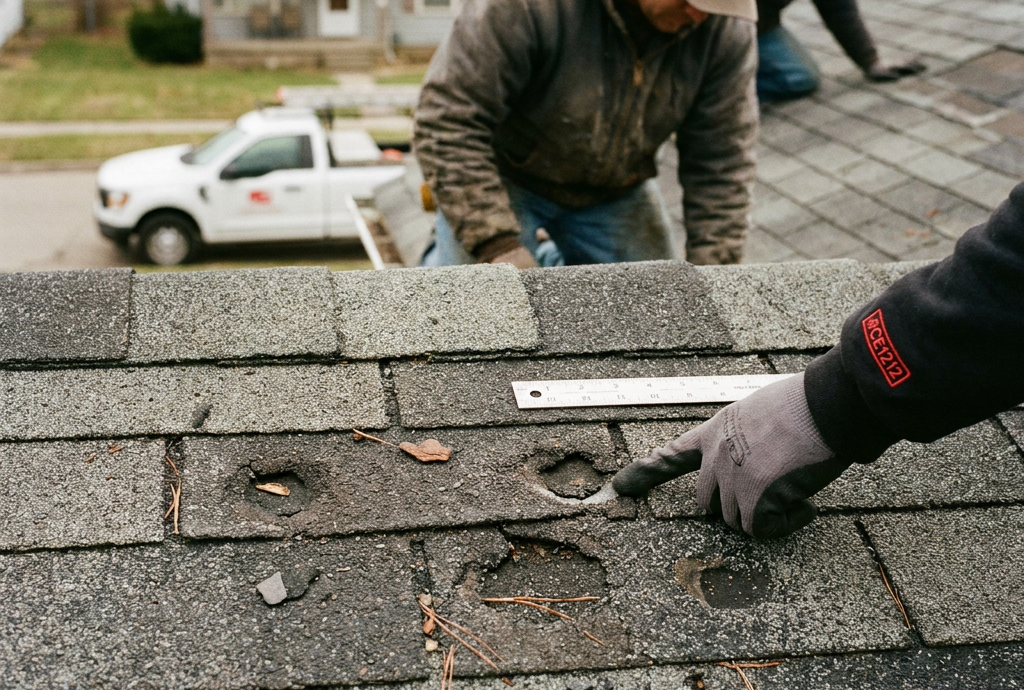
On asphalt shingles, a hail strike creates a soft spot where the granules (the small, sand-like coating on the surface) are knocked loose or pressed into the asphalt mat underneath. If you press on the spot with your thumb, it gives slightly, like a bruise on an apple. The exposed area underneath is usually dark, and the edges of the granule loss are sharp and well defined.
Look at the soft metals on your roof too. Aluminum vents, exhaust caps, and flashing dent easily. If those show circular impact marks, your shingles likely took the same hits. Gutters and downspouts can confirm the pattern, and so can any aluminum siding.
Golf-ball-sized hail (about 1.75 inches in diameter) damages nearly all roofing materials. Quarter-sized hail (1 inch) can damage most standard asphalt shingles, especially if the roof is older than 10 years. Mid-Michigan sees this regularly. The Lansing area recorded 41 radar-detected hail events and 38 severe weather warnings in the past 12 months alone.
Key takeaway: Hail damage is random, circular, and confirmed by matching dents on vents, gutters, and other soft metals around the roof.
What Normal Wear Looks Like (and Why It Gets Confused With Hail)
Normal aging is gradual and uniform. Granule loss from wear shows up evenly across large sections of the roof, not in scattered circles. The shingle surface looks washed out or faded rather than dented. You’ll often find granules collecting in your gutters after heavy rain, which is part of the natural lifecycle of an asphalt roof.
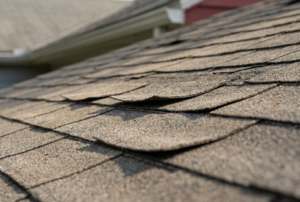
Curling is another sign of age. Shingles curl upward at the edges or cup in the center as the asphalt dries out over years. This happens most on south-facing slopes where UV exposure is strongest. Curling is not caused by hail.
Cracking follows a similar pattern. Age-related cracks tend to run in straight lines, often following the grain of the fiberglass mat. They look different from impact fractures, which radiate outward from a central point.
Michigan’s freeze-thaw cycle complicates things. A hail strike that cracks the shingle surface in June lets water in before the first freeze in November. That water expands, widens the crack, and by April you have a section of compromised shingles that looks like aging but started with a single impact. This is one reason a prompt inspection after a storm matters: damage that’s easy to identify in July is much harder to distinguish from wear by the following spring.
If you’re seeing early signs that your roof needs attention, a professional inspection can tell you whether the cause is storm-related or age-related. That distinction determines whether your insurance covers the fix.
Key takeaway: Normal wear is uniform and gradual. Michigan’s freeze-thaw cycle can make old hail damage look like aging, which is why timing matters.
The Misidentification Guide: Four Damage Types Homeowners Mix Up
This is where most online guides stop. They tell you hail is random and wear is uniform, and then they move on. But homeowners call us about four specific confusion points that nobody else covers in plain language.
Blistering vs. Hail Damage
Blisters form when moisture trapped inside the shingle expands in the heat. They create raised bumps that can pop, leaving a pit in the surface. The difference: blistering pits have steep sides and a small exposed area. Hail dents are shallower, wider, and surrounded by a ring of displaced granules. Blistering also shows no collateral damage on vents or gutters, because nothing hit them.
Foot Traffic Marks vs. Hail Damage
Scuff marks from walking on a roof follow logical paths: along ridges, from the ladder to the vent, around HVAC units. Hail doesn’t follow pathways. If the granule loss traces a route someone would walk, it’s foot traffic. If it’s scattered across the entire slope with no pattern, it’s weather.
Manufacturing Defects vs. Storm Damage
Defective shingles show consistent, repeating patterns. The same crack in the same spot on every third shingle. The same granule adhesion failure across an entire production run. Storm damage is random by nature. Consistent defects across many shingles point to a manufacturing issue, which may be covered by the shingle manufacturer’s warranty rather than your homeowner’s insurance.
Wind Damage vs. Hail Damage
Wind lifts, creases, and tears shingle tabs. The damage follows the direction the wind was blowing, and you’ll see lifted edges, creased fold lines, or missing tabs. Hail creates circular dents and doesn’t lift or crease anything. A roof can have both from the same storm, and your adjuster should document each type separately. Understanding what to do after a storm damages your roof helps you document both types before the adjuster arrives.
Key takeaway: Blistering, foot traffic, manufacturing defects, and wind damage all get mistaken for hail. Each has a distinct visual signature that a trained eye can identify.
What Insurance Adjusters Look For (and What Their Thresholds Mean)
When an adjuster climbs your roof, they’re applying a specific method. Most follow the Haag Engineering standard, which is the industry benchmark for hail damage assessment.
The adjuster picks representative areas of your roof, typically 10-foot by 10-foot squares called “test squares.” They count the number of hail hits within each square. The general threshold for a replacement recommendation is eight or more hits per test square, though this varies by insurer and shingle type.
Adjusters also distinguish between functional damage and cosmetic damage. Functional damage compromises the shingle’s ability to keep water out: cracked mats, exposed fiberglass, missing shingle sections. Cosmetic damage affects appearance but not performance: minor granule loss, small dents that don’t crack the surface. Many policies in Michigan cover functional damage but exclude or limit cosmetic damage. Check your policy language, or ask your agent to explain what’s covered.
Collateral damage strengthens your claim. If the adjuster sees dents on your roof vents, exhaust caps, gutters, window screens, and air conditioning units, that confirms a hail event hit your property. This corroborating evidence is harder to dispute than shingle damage alone.
If you’re considering filing a claim, understanding the insurance claim process in Michigan before your adjuster visits gives you a significant advantage.
Key takeaway: Adjusters count hits per test square and look for collateral damage on metals. Knowing their method helps you understand their decision.
When the Adjuster Says “Wear and Tear” and You Disagree
Sometimes the adjuster gets it right. Normal wear is not a covered peril, and filing a claim on an aging roof wastes your time and puts a claim on your record. A good contractor will tell you that.
But sometimes the adjuster gets it wrong. If you believe your roof has hail damage that the adjuster missed, you have options under Michigan law:
Request a reinspection. Call your insurance company and ask for a second adjuster. Provide any documentation you have: photos of collateral damage on metals, a report from a licensed roofing contractor, or a timeline showing the damage appeared after a specific storm event.
Get an independent contractor assessment. A local roofer who inspects storm damage regularly can provide a written assessment of the damage type and extent. This isn’t a competing claim; it’s a second professional opinion. What to expect during a roofing inspection covers what a thorough assessment includes.
Use the appraisal clause. Most Michigan homeowner’s policies include an appraisal clause. If you and your insurer disagree on the damage amount, either party can invoke this clause. Each side hires an independent appraiser, and the two appraisers select an umpire. The majority decision is binding.
File a complaint with Michigan DIFS. The Department of Insurance and Financial Services handles disputes between homeowners and insurers. You can reach them at 877-999-6442. Filing a complaint doesn’t guarantee a reversal, but it does create a formal record and triggers an investigation.
Important timing note: Most Michigan policies require you to report damage within 60 to 90 days of the event. Don’t wait months to file. Even if you’re unsure, document the damage early and consult a contractor before your window closes.
Key takeaway: You can request a reinspection, get an independent assessment, invoke the appraisal clause, or file a DIFS complaint. Document early and know your timeline.
Why the Honest Answer Protects You
The roofing industry has a storm-chaser problem. After a hailstorm, out-of-state crews knock on doors and tell homeowners they need a full replacement. Sometimes they’re right. Often, they’re telling every homeowner the same thing regardless of what’s actually on the roof.
The honest answer is that not every roof needs replacing after a storm. Some need repairs. Some need nothing at all. A contractor who tells you your roof is fine when it’s fine is a contractor you can trust when it’s not.
That’s the principle behind our Repair First approach. If your roof can be repaired, we repair it. If you end up needing a replacement within a year, we apply the cost of that repair (up to $1,000) as a credit toward the new roof. You don’t lose money by trying the conservative option first.
Before hiring any roofer after a storm, verify their Michigan contractor license through Michigan LARA (Licensing and Regulatory Affairs). A licensed, insured local contractor who will be in your community next year is a different proposition than a crew that arrived three days ago from out of state and will be gone by fall.
We also recommend learning how Michigan’s summer storms can quietly damage your roof so you know what to watch for throughout the season, not just after the big events.
Key takeaway: A contractor who tells you when you don’t need a new roof is the one worth calling when you do.
Not Sure What You’re Looking At? Start Here.
If you’ve read this far, you know more about hail damage identification than most homeowners ever learn. But reading about it and seeing it on your own roof are two different things.
We inspect hundreds of roofs every storm season across Lansing, Howell, Brighton, Owosso, and the surrounding Mid-Michigan communities. Schedule a free hail damage assessment. We’ll tell you what we see, explain whether it’s hail or wear, and walk you through your options. If it turns out your roof is fine, we’ll tell you that too.
Schedule a free assessment.Ask Roofster.