Curling Shingles: How to Read the Damage on a Michigan Roof
Have a question about this topic?
Have a question about this topic?
Ask Roofster — our AI roofing expert is available 24/7.
Ask Roofster — our AI roofing expert is available 24/7.
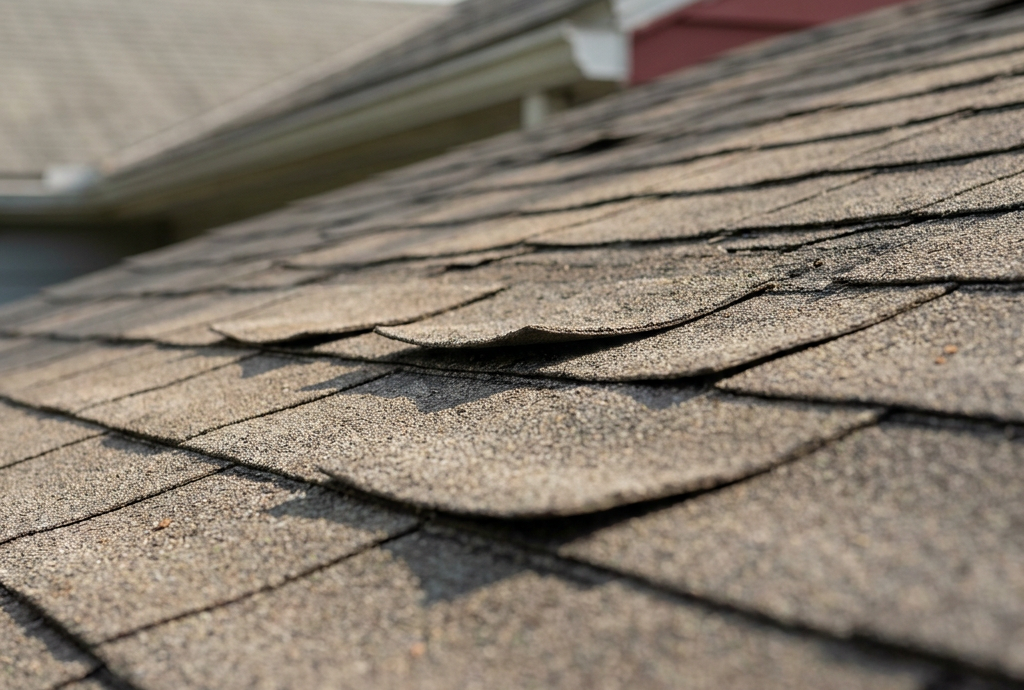
Curling shingles come in two shapes, and the difference is readable from the ground. On some roofs the edges of each shingle turn up while the middle sinks into a shallow dish. On others the edges stay flat and the middle rises, or the bottom tabs curl down.
The two shapes have different causes and different urgency. Sorting which one is on your roof, along with the roof’s age and what is collecting in the gutters, gets you most of the way to knowing whether this is ordinary aging or something to handle before winter.
Cupped Edges and Clawed Centers Point to Two Different Problems
What is the difference between cupping and clawing shingles?
Cupping is when the edges of a shingle turn up and the center dishes into a concave shape, usually from moisture trapped underneath or attic heat baking the shingle from below. Clawing is when the edges stay flat while the center bulges up or the tabs curl down, usually from an aging shingle whose asphalt has gone brittle and lost its grip on the mat, the fiberglass sheet the shingle is built on.
As an asphalt shingle ages, its asphalt contracts around a fiberglass mat that does not shrink: the asphalt pulls, the mat holds, and the edge has nowhere to go but up. That tension comes with how an asphalt shingle is actually built.
The shape narrows the cause without proving it. Sources disagree at the edges of the distinction, and reading a shape from forty feet has limits, which is the territory what you can’t see from the ground covers.
Key takeaway: Cupped edges point to moisture or heat. A clawed center points to age.
Curling Before Year Twelve Means Something Other Than Age
At what age do shingles start curling?
Curling is rare on shingles younger than about twelve years, a benchmark from the National Roof Certification and Inspection Association. Age does most of the sorting.
Under about twelve years, age is not the explanation and something specific is: usually attic ventilation, sometimes a second layer of shingles laid over the old one (a roof-over, which traps heat and moisture between the layers), sometimes nailing or adhesive-strip placement. Whatever it is keeps working on the rest of the roof.
Past twelve years, curling is ordinary. It puts the shingle in the second half of its service life, where deterioration accelerates. Asphalt shingles are generally built for roughly twenty to thirty years depending on grade and climate.
Curling rarely arrives alone, and the other early signals worth checking at the same time make a short list.
Key takeaway: Under twelve years, curling has a findable cause. Past twelve, it is age.
Trapped Attic Air Is the Most Common Reason a Young Roof Curls
Poor attic ventilation is the cause named most often for curling on a young roof, and the one you can check without a ladder.
Warm, moist air rises from the house into the attic. A working attic sends it straight back out: soffit vents along the eaves pull cool air in, a ridge vent along the peak lets warm air escape. When intake or exhaust is blocked, that air sits against the underside of the roof deck, the plywood under the shingles, and works the shingle from both faces.
Four checks from inside:
- A musty smell in the attic.
- Frost or condensation on the rafters in winter.
- An attic noticeably hotter than the rest of the house.
- Bathroom or kitchen fans that end in the attic instead of venting outside, a common and fixable source of the moisture.
A vented attic can still fail, for reasons more specific than too few vents; why a roof’s ventilation stops working goes through them.
Key takeaway: Musty air, frost on the rafters, and fans venting indoors all point at ventilation.
A Michigan Winter Turns a Hairline Crack Into an Open Seam
Michigan does not freeze a roof in December and hold it there until March. The temperature crosses freezing and comes back, over and over, all season, and asphalt is flexible when warm and brittle when cold, so every crossing flexes a stiffened material.
Water does the rest. It works into a hairline crack or under a lifted edge, freezes, and takes up about nine percent more room as ice. The thaw lets a little more water in, and the next freeze widens the gap again. Run that through one winter and a crack becomes a seam.
The sealant strip, the glue line bonding each course of shingles to the one below, needs warmth and sun to re-bond once it lets go, and a Michigan January supplies neither. A shingle that lifts in November stays lifted until spring. A broken seal is one of the things winter exposes about how a roof was built.
Granules loosen on the same cycle, which our Metal Roof vs. Asphalt Shingles comparison covers from the material side, and they land somewhere easier to inspect.
Key takeaway: A seal broken in November cannot re-bond until spring.
Granule Loss in the Gutters Tells You Where the Roof Is in Its Life
Is granule loss on shingles normal?
Some of it is. Granules, the mineral coating that shields the asphalt from sunlight, are applied in excess at the factory, and the loose ones wash off in the first storms after installation. Shedding continues at a low rate afterward.
Three patterns are different:
- Bare black asphalt showing through in patches, which is the signal that counts.
- Heavy accumulation years into the roof’s life rather than months after installation.
- Loss concentrated in one area instead of spread evenly.
Look in the gutters, at the splash zone under a downspout, and on the ground below the eaves.
Repeated expansion and contraction loosens the granules’ hold on the asphalt, and a cold, brittle surface sheds more when ice moves across it, which is why gutters look worst at the first thaw. Concentrated loss can also be impact rather than age, and telling impact damage apart from ordinary wear sorts them.
Key takeaway: Granules in the gutter are normal. Bare asphalt is not.
Proportion Decides Whether This Is a Repair
How much of the roof is curling matters more than which shape it is. The inspection benchmark is 10 to 15 percent of the surface: past that it is no longer a localized repair, and below it, often still is. Proportion is the hardest thing to judge from the driveway, and the repair-or-replace comparison covers that decision.
Curling shingles are not an emergency, and they are not a wait-and-see either. What turns a curled edge into a leak is a winter, so the useful window is before one.
Have Someone Read the Whole Roof
Weather Vane Roofing inspects Repair First, so the report tells you when a repair is enough, and the $1,000 Repair Credit Guarantee puts the price of a repair toward a replacement if you need one inside a year. Complete roofing jobs carry a lifetime workmanship guarantee, with offices in Lansing and Owosso. Schedule an inspection, or describe what you are seeing to Ask Roofster.