Should You Call a Roofer or Your Insurance Company First After Storm Damage?
Have a question about this topic?
Have a question about this topic?
Ask Roofster — our AI roofing expert is available 24/7.
Ask Roofster — our AI roofing expert is available 24/7.
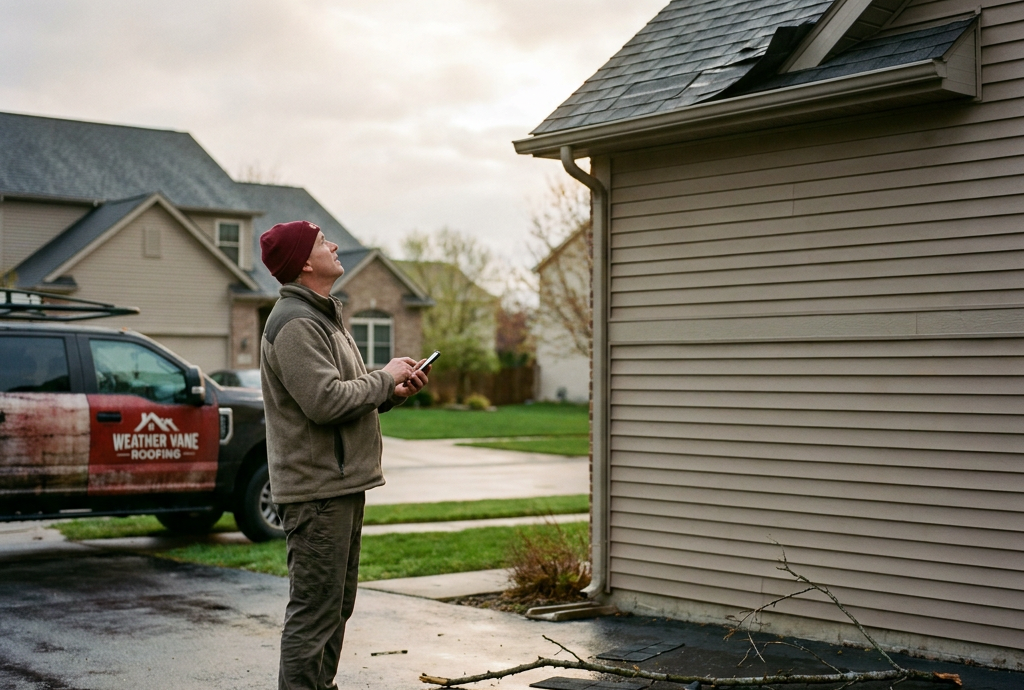
The storm just passed. There are shingles in the yard, a branch on the garage, and you’re standing in the driveway with two numbers pulled up on your phone: your insurance company and a roofing contractor.
Which one do you call first?
If you search online, you’ll get two opposite answers depending on who wrote the article. Roofing companies say to call a roofer first. Insurance companies say call them first. Both sides have reasons, and both sides have a financial interest in being your first call.
Here’s the honest answer: the right move depends on your situation. And there are really only three situations you can be in right now.
Three Scenarios, Three Different First Calls
Your roof is actively leaking or you have structural damage. Call a roofer first. You need emergency tarping or stabilization to prevent water from causing more damage inside your home. Once the leak is contained, call your insurance company to file the claim. Your policy covers reasonable emergency repairs, so save every receipt.
You have significant visible damage — missing shingles, dents, debris impact — but no active leak. Call a local roofer for a free storm damage inspection. Their documented findings give you solid evidence to support your claim when you file. You’re not going in blind.
The damage looks minor or you’re not sure if there’s damage at all. Get a professional inspection first to find out whether the repair cost exceeds your deductible. If it doesn’t, filing a claim creates a record with zero benefit to you.
Key takeaway: Emergency leaks need a roofer first. Everything else benefits from a professional inspection before you pick up the phone with your insurer.
Why a Professional Inspection Before Filing Usually Makes Sense
This isn’t a sales pitch for roofing companies. It’s practical.
A qualified roofer can tell you whether the damage is actually worth filing a claim over. If the repair costs less than your deductible, filing only creates a record in CLUE (the Comprehensive Loss Underwriting Exchange, which is the database insurers use to track your claim history) with no payout. That record can follow you for five to seven years.
Reputable local roofers, including Weather Vane, offer free storm damage inspections. It costs you nothing to find out where you stand.
A roofer’s documented inspection also gives you evidence. When you file with photographs, measurements, and a professional assessment already in hand, you’re starting from a position of knowledge rather than guessing at the scope.
One more thing worth knowing: getting a roofer inspection first does not jeopardize your insurance claim. Your insurer cannot deny a claim because you had a contractor look at the damage before you called them.
When Calling Insurance First Is the Right Move
There are situations where your insurance company should be your first call, and it’s worth being honest about that.
Your policy explicitly requires it. Some policies have specific notification timelines. Read your declarations page. If it says “notify within 72 hours,” honor that.
The damage is obviously catastrophic. If a tree came through the roof or you’re looking at large sections of exposed decking, you already know you’re filing. Get it timestamped.
You want guidance before making any decisions. Some homeowners feel more comfortable starting with their insurer, and there’s nothing wrong with that. Your adjuster can explain your coverage, your deductible, and what to expect before you talk to a contractor.
The important thing is being informed, not rushed. Michigan gives you up to 12 months from the date of damage to file in most cases, though filing within the first few weeks produces the strongest documentation.
The Deductible Question: Is Filing Even Worth It?
This is the math most articles skip, and it’s the calculation that matters most.
If your estimated repair cost is below your deductible, filing a claim gets you nothing except a CLUE record. That record stays on file for five to seven years, and future insurers can see it when you apply or renew.
A practical rule of thumb: if the estimated repair is less than 1.5 times your deductible, think carefully before filing. On a $1,000 deductible, that means damage under $1,500 may not be worth the claim.
Here’s why the math matters in Michigan specifically. A single weather-related claim typically does not raise your premiums significantly. Michigan treats storm damage as “Acts of God,” and a single weather claim often results in a 7 to 10 percent increase or no increase at all. But multiple claims within three to five years can push premiums up 25 to 40 percent. Every claim counts, so make sure each one is worth filing.
A free inspection from a local roofer gives you the repair estimate you need to make this decision before you commit to a claim.
Key takeaway: If the repair costs less than your deductible, don’t file. A claim on your record with no payout only hurts you.
What Your Roofer Should Do at the Adjuster’s Inspection
In Michigan, you have the right to have your contractor present when the insurance adjuster inspects your roof. Most homeowners don’t know this, and it’s one of the most valuable things you can do for your claim.
Your roofer isn’t just standing there. They’re identifying damage the adjuster may miss, particularly in roof valleys, at flashing points, and on the underside of the roof deck. Insurance adjusters assess many types of property damage across homes, vehicles, and commercial buildings. A roofing contractor is a specialist. That expertise gap is where claim value gets lost.
Your roofer also ensures code-required items are included in the scope. In Michigan, ice and water shield in valleys is a building code requirement. If the adjuster’s estimate doesn’t include it, your contractor can flag it on the spot.
If hidden damage shows up during tear-off (rotted decking, failed underlayment, moisture damage that wasn’t visible from the surface), your contractor can file a supplement. A supplemental claim recovers the additional cost of repairing damage that wasn’t in the original scope. This is standard practice, and it can add 30 to 50 percent more value to your claim. Having a contractor involved from the beginning ensures the original scope is as complete as possible, and supplements are documented properly when they’re needed.
A Word About Storm Chasers
The “who do I call first?” moment is exactly when storm chasers target homeowners. Within 48 hours of a major storm, trucks with out-of-state plates start rolling through Michigan neighborhoods offering to “handle everything with your insurance.”
Watch for these red flags: out-of-state plates, pressure to sign before your claim is processed, offers to waive your deductible (this is insurance fraud in Michigan), and no verifiable Michigan contractor license.
Before you sign anything with any contractor, verify their license at michigan.gov/lara. If they’re not in the system, walk away.
Frequently Asked Questions
Should I call my roofer or insurance company first after storm damage?
It depends on your situation. Active leaks need a roofer for emergency tarping first, then insurance. Significant visible damage benefits from a professional inspection before filing. Minor or unclear damage should be inspected to determine if the repair exceeds your deductible before you put a claim on record.
Does filing a roof insurance claim raise my premiums?
In Michigan, a single weather-related claim usually results in a modest increase (7 to 10 percent) or no increase at all. Storm damage is treated as an “Act of God.” However, multiple claims within three to five years can increase premiums by 25 to 40 percent.
Can my insurance deny my claim if a roofer inspects first?
No. A professional inspection strengthens your claim by providing documented evidence of the damage. Your insurer cannot deny a claim because a contractor looked at the roof before you filed.
How long do I have to file a roof damage claim in Michigan?
Most Michigan homeowner’s policies allow 12 months from the date of damage, and some allow up to two years. Check your policy’s conditions section. Filing within the first few weeks produces the strongest claim because the damage is fresh and well-documented.
What if my roof damage is below my deductible?
Don’t file. Get it repaired and keep the claim off your record. A CLUE record with no payout only counts against you. If you need help understanding what the repair will cost, a free inspection gives you that number.
Get the Truth Before You Decide
Not sure whether your storm damage is worth a claim? Weather Vane Roofing will tell you the honest answer. Schedule a free storm damage inspection and we’ll document what we find, walk you through your options, and help you decide what makes financial sense for your situation. No pressure, no surprises.
You can also Ask Roofster for quick questions anytime.