Roofing Scams in Michigan: How to Spot and Avoid Them
Have a question about this topic?
Have a question about this topic?
Ask Roofster — our AI roofing expert is available 24/7.
Ask Roofster — our AI roofing expert is available 24/7.
Most people expect a roofing scam to announce itself: bad grammar on the flyer, an unmarked van, a price too good to be true. The versions that work look like a functioning roofing company. Lettered truck, printed contract, a folder of before-and-after photos, a crew using the same vocabulary your neighbor’s roofer used. Appearing legitimate is the business model.
Said plainly up front: the large majority of Michigan roofers are honest tradespeople who do good work. That is also what makes the small number who are not so hard to spot. They work inside a trade homeowners already trust.
Roofing Is a Target Because You Cannot See What You Are Buying
Roofing combines four things that rarely appear together. It is a five-figure decision, usually made in days rather than months because water is already getting in, about a surface the homeowner will never stand on. It is also frequently paid for with an insurance company’s money rather than the homeowner’s own.
The out-of-town crews that appear after a hailstorm are the version most homeowners already recognize, and they work for the same reason as everything below: speed, and a roof nobody can inspect. The rest do not arrive in a caravan.
Key takeaway: Roofing scams need a fast decision and a product the buyer cannot see.
The Same Five Scams Keep Working in Michigan
The Michigan Attorney General’s office issues recurring post-storm warnings, most recently after March 2026 winter weather in Northern Michigan. The advisories describe people posing as adjusters, meaning the insurance company’s damage inspector, or contractors soliciting door to door, and requests for banking details in exchange for supposed government repair funding.
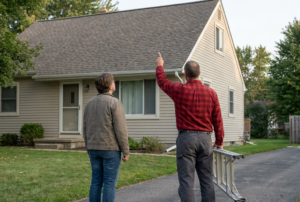
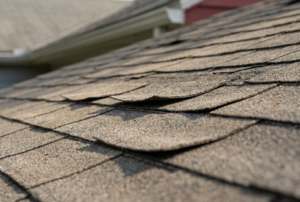
- The free inspection that finds damage that was not there. The money is in the size of the job, so the inspection finds a bigger one, or creates it. The tell is an inspector who cannot show you the damage in a photo and explain how it happened. Ask for photos, be in the house while anyone inspects, and know what a real inspection involves.
- The low bid that grows once the shingles come off. The bid wins the job; the change orders, meaning written amendments that add cost mid-job, produce the margin. The tell is a quote far below the others, vague about rotten decking. The contract should name what triggers a price change and by how much, and leave no blanks. Compare quotes on what an estimate should contain beyond price.
- The deposit far larger than the materials require. A deposit covers materials ordered ahead of the job, not a large share of the contract before anyone has been on the roof. Angi, the consumer home-services marketplace, puts a reasonable down payment at 15% or less of the total project price, a marketplace guideline rather than a Michigan rule. Michigan’s Department of Insurance and Financial Services (DIFS) adds the tell: never pay cash in advance, never sign under pressure.
- Work done by someone not licensed for it. An unlicensed crew has nothing to collect against when the roof leaks in eighteen months. The tell is a contractor who asks you to pull the permit, moving responsibility to your name.
- The warranty nobody intends to honor. A spoken “lifetime warranty” from a business with no fixed address is a sales line. The tell is that it is verbal and nobody can say what it excludes. Every warranty excludes something, so ask what a roof warranty usually excludes before signing.
Key takeaway: All five sell more roof than the house needs. A written scope and a night to think defeat them.
An Offer to Cover Your Deductible Puts Your Name on the Paperwork
The pitch sounds like a favor. The contractor offers to waive, absorb, or eat your deductible, the amount your policy requires you to pay before coverage begins, framed as a discount for signing today.
The arithmetic works one way. For the contractor to be paid in full while you pay nothing out of pocket, the amount billed to the insurance company has to exceed what you actually spend. The claim then describes a cost you never bore, and your name is on it. If the insurer reviews that file a year from now, it is your file.
So pay the deductible, keep the claim accurate to what was actually spent, and deal with your insurance company directly; filing the claim yourself, in the right order is not difficult. Two related requests deserve the same answer: a contractor who wants your insurance check signed over, and one who wants an assignment of benefits, a document handing your claim rights to the contractor, signed before any scope of work exists.
Key takeaway: A contractor absorbing your deductible is asking you to sign a claim that misstates what you paid.
There Is No Roofing License in Michigan, and Checking the Right One Takes Two Minutes
Michigan does not issue a standalone roofing license. Roofing is a specialty classification under a Residential Maintenance & Alteration Contractor license, or it falls under the broader Residential Builder license, both from the Bureau of Construction Codes at Michigan’s Department of Licensing and Regulatory Affairs (LARA). Residential construction and repair work valued at $600 or more is widely reported to require one of the two. A contractor claiming to hold “a Michigan roofing license” is describing something that does not exist.
Checking the real one takes two minutes:
- Open LARA’s public license lookup. No account is required.
- Search by business name, assumed name, license number, or county.
- Confirm the license class covers residential building or maintenance and alteration work.
- Confirm it is active. Records refresh once a day, so a license issued this week may not appear yet.
Then ask for the certificate of insurance, the insurer’s own document showing the policy is in force, from the insurance company directly rather than from the contractor, and check the dates. What Licenses and Insurance Should a Michigan Roofer Have? covers the longer version, including what each license class permits.
Key takeaway: Michigan has no roofing license. It has a contractor license, and the lookup takes two minutes.
Michigan Has Three Places to Report Roofing Fraud, Depending on What Happened
Suspected insurance fraud goes to the DIFS Fraud Investigation Unit at Michigan.gov/ReportFraud2DIFS or 877-999-6442. Most reports can be made anonymously.
A contractor who took the money and did not do the work, used poor materials, or significantly overcharged goes to the Attorney General’s Consumer Protection team at 877-765-8388.
Anyone who contacted you claiming to be from LARA goes to LARA-Safety@michigan.gov. LARA states on its own site that it will never ask for credit card numbers or other personal information by phone, text, email, or letter, and it has warned about fraudulent emails impersonating LARA officials. That address is for fraud only, not license questions or complaints.
Key takeaway: Reporting is free and often anonymous. Where it goes depends on what happened.
Nothing Gets Signed on the Day Someone Knocks
One habit defeats all five and costs nothing: nothing gets signed and nothing gets paid on the day someone first knocks. A legitimate roofer is still reachable tomorrow, puts the scope in writing, and will not mind you looking up the license while they wait. Pressure to decide today is itself the tell.
Get a Second Opinion Before You Sign Anything
Weather Vane Roofing works Repair First, which means we say so when a repair will do, and the $1,000 Repair Credit Guarantee puts the cost of that repair toward a replacement if you end up needing one within the year. Licensed and insured, with offices in Lansing and Owosso and a lifetime workmanship guarantee on complete roofing jobs. Request a free estimate when you want a real look at your roof, or ask Roofster, the 24/7 chat assistant, if you only want to check one thing first.