How Long Does a Roof Replacement Take? What Michigan Homeowners Should Expect
Have a question about this topic?
Have a question about this topic?
Ask Roofster — our AI roofing expert is available 24/7.
Ask Roofster — our AI roofing expert is available 24/7.
On a typical Mid-Michigan house with asphalt shingles, the crew is on your roof for one to three days. The project around those days — estimate, contract, material order, permit, a slot on the schedule, a final inspection — usually runs three to six weeks.
Most of that span is waiting rather than working. Pitch, old shingle layers, and the condition of the wood underneath move the days on the roof; the permit and how booked the calendar is move the weeks.
The Crew Is on Your Roof for One to Three Days. The Project Takes Three to Six Weeks.
Those two numbers answer different questions about how long it takes to replace a roof: one to three days is how long you will hear work over your head, and three to six weeks is what you plan around. What a replacement involves beyond the schedule is a separate guide; this one is about the clock.
| Stage | Typical duration |
|---|---|
| Estimate visit and measurement | 45 to 90 minutes |
| Contract signed, materials ordered | a few days to a week |
| Permit pulled by the roofer | a few days to two weeks |
| Wait for a slot on the schedule | one to four weeks, longer in fall |
| Tear-off and installation | one to three days |
| Final inspection, permit closed | a few days to two weeks |
The estimate visit starts the clock and is over in under two hours; what the inspector is looking at is its own subject.
Ordering material takes days after you sign, and the question that arises there is cost, which what a replacement runs in Michigan answers.
The roofer pulls the permit, not you, from your city or township building department; in Lansing that is the Building Safety office. Permits and inspections add more days at the front of a project than anything else, and both exist to protect the homeowner.
Key takeaway: One to three days of work sits inside a three-to-six-week project, and most of the gap is waiting.
Tear-Off and New Shingles Usually Happen the Same Day
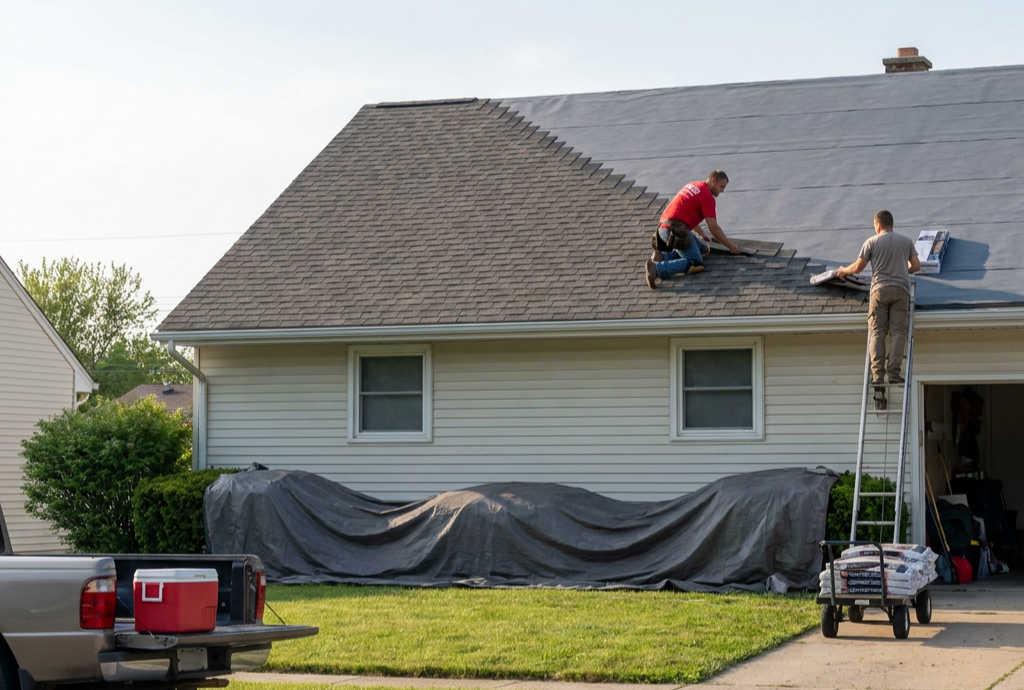
Trucks and a dumpster are in the driveway before eight. Catch-all tarps go down over siding, windows, and landscaping, and material moves in roofing buggies, wheeled carts that keep heavy loads off your lawn.
Tear-off, stripping the old shingles down to bare wood, happens a section at a time rather than across the whole roof, so only part of the deck (the plywood or board sheathing under the shingles) is ever open, each section checked as it appears. Underlayment, the water-resistant layer that goes on before shingles, follows immediately, with ice-and-water shield, a sealed waterproof membrane, along the eaves and valleys. Before dark the roof is dried in: watertight, even without the finish shingles. Shingles, flashing (the metal that seals joints and edges), drip edge (the strip that sends water into the gutter), and a ridge vent along the peak finish it. The day ends with a magnet sweep of the yard for nails.
You do not need to be home. Move the cars out the night before, plan for real noise directly overhead, and take pictures off the walls in the rooms below, because the vibration will knock them loose.
Can a roof be replaced in one day? Yes, on a small, simple, single-layer roof with a full crew and dry weather. That is not most houses.
Key takeaway: Tear-off and new shingles happen the same day, and the roof is dried in before the crew goes home.
Rain Falls on Roughly One Michigan September Day in Three, So the Job Is a Window, Not a Date
The Lansing area averages rain on about 11 days in September. A two-day job scheduled against those odds realistically spans three or four, so a good roofer gives you a start window rather than a single date.
A weather delay costs days, not damage. When rain moves in, the crew stops on a roof that is already dried in and comes back when the deck is dry enough to work on. Morning dew alone can push a start by an hour or two, because nothing bonds properly to damp wood. From the driveway it is trucks leaving early and a roof that looks unfinished but is not open.
If your next thought is whether you should have aimed at a different month, which window to pick and how far ahead to call is a separate decision with its own answer.
Key takeaway: A rain delay costs calendar days, not damage, because the deck is left dried in every evening.
Pitch, Layers, and What’s Under the Shingles Move the Number More Than Square Footage Does
Square footage is the variable people expect to dominate, and it is the least interesting. Pitch, meaning how steep the roof is, matters more: a steep roof slows every trip across it and needs safety rigging before anyone starts. A second or third layer of old shingles doubles or triples the tear-off. Valleys, dormers, skylights, and chimneys mean hand-cut flashing that extra crew cannot speed up.
Material changes the clock too: steel panels and asphalt shingles do not install on the same schedule, a tradeoff the forthcoming Metal Roof vs. Asphalt Shingles guide covers.
The genuine unknown is the roof deck. Nobody knows the condition of the wood until the shingles are off, and soft or rotted sheathing adds a day, plus a mid-project inspection in most Michigan municipalities before new material can go on. Occasionally what comes off says repair rather than replacement, so whether the damage you have actually needs a full replacement is worth settling first. Weather Vane Roofing’s Repair-First approach starts there.
Key takeaway: Pitch, layer count, and deck condition move the timeline more than square footage does.
Those same factors move the price, too. See financing options and get your roof replaced now with 100% financing and no money down.
In September and October, the Wait for a Start Date Is Longer Than the Job
September and October are the most-booked months for roof replacement in Michigan, and in that window the wait for a slot commonly runs longer than the install itself. That is a scheduling fact, not a reason to hurry: the fall stretches the front half of the timeline, not the days on the roof.
If you have an active leak while you wait, what to do before a roofer can get there covers the stopgap.
Ask for the start window, the weather-delay policy, and who will be on site, in writing on the contract. A two-day job that runs four then reads as an expectation met rather than a surprise, and it is one of the things worth looking for in an estimate.
Key takeaway: In fall the wait to start stretches; the install does not. Get the start window and weather-delay policy in writing.
Ask for the Window, Not the Date
Homeowners happiest with how a replacement went are usually the ones who knew going in that a two-day job occupies a three-week calendar. The days on the roof are the short part of it.
Get the Timeline for Your Own Roof
The ranges here become your number only after someone stands on your roof, counts the layers, measures the pitch, and checks the deck. Weather Vane Roofing gives free estimates across Lansing, Howell, Brighton and Owosso, and the visit includes a straight answer on whether you need a replacement yet. If a repair will do, the $1,000 Repair Credit Guarantee puts that cost toward a replacement within the year. Request a free estimate, or ask Roofster how long your own roof would take.