Roof Storm Damage in Michigan: What to Check and What to Do

Have a question about this topic?
Have a question about this topic?
Ask Roofster — our AI roofing expert is available 24/7.
Ask Roofster — our AI roofing expert is available 24/7.
Most homeowners who go looking for storm damage do not know which kind they are looking for, and that is the part that decides what happens next: whether the roof needs attention tonight or in April, whether a claim is worth opening, and whether a repair will do instead of a replacement. Wind, hail, water, and debris each leave a different signature, and each runs on its own clock.
You Can Spot Most Storm Damage Without Getting on the Roof
Storm damage shows up in five ways a homeowner can check from the ground or from inside, and the roof damage signs visible from the driveway do not all need the same response speed. The common types of roof damage, sorted by urgency:
- Water coming in now. An active drip or a spreading ceiling stain is a same-day problem.
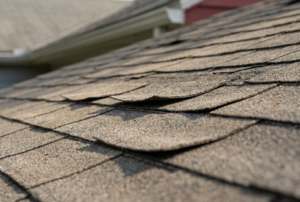
- Shingles missing, lifted, or creased. Days, not weeks. The next rain finds the gap.
- Granules in the gutters or under the downspouts. Granules shield the asphalt underneath from sun, so losing them shortens the roof’s life rather than ending it. Weeks, not days.
- Flashing or gutters bent or pulled loose. Flashing is the metal that seals roof edges, valleys, and anything coming through the roof. Same timeline, visible with binoculars.
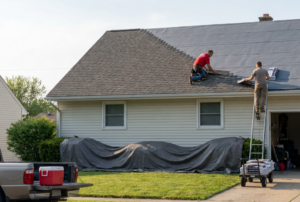
- Debris sitting on the roof. It needs to come off, by someone who is not you.
Decking (the wood sheathing under the shingles) can be compromised in ways nothing from the ground reveals, so do not climb a storm-damaged roof. A roof damage inspection covers what a ground-level look always misses.
Key takeaway: All five are worth acting on. Only one is worth acting on tonight.
Wind Can Compromise a Roof While Leaving Every Shingle in Place
Two of those signs come from wind, which does most of its damage by uplift: it catches a shingle edge, pulls upward, and breaks the factory sealant bond holding each course to the one below. The shingle falls back into place and looks untouched from the driveway while sealed to nothing. Michigan supplies plenty of it: a 96 mph gust was recorded in Jackson in June 2026, along with two confirmed tornadoes in the state that month.
An intact-looking roof is not proof it came through fine. What high wind does to a roof covers how creasing shows up and what it costs unrepaired.
Key takeaway: A roof with every shingle in place can still have lost its seal, and that is invisible from the ground.
Hail Damage Looks Like Ordinary Aging, Which Is Why It Gets Missed
Granules in the gutter often point at hail. Hail bruises the asphalt mat, the layer under the granules that does the waterproofing, and knocks the granules loose. The marks are invisible from the ground and read like ordinary aging even from a ladder. Michigan’s hail arrives in scattered bursts a few years apart rather than every season, so it is not the first thing a homeowner here checks for. Mid-May 2026 put 2-inch hail on the ground in Unionville, in Tuscola County. What hail actually leaves behind is worth knowing before writing a roof off as old.
The harder question is whether the storm caused what you are looking at or the years did, and that decides whether there is a claim. Telling hail from ordinary aging is worth a second opinion.
Key takeaway: Hail damage and normal wear look alike from a distance, and mistaking one for the other is how a claim goes unfiled.
Michigan’s Summer Storms and Winter Storms Damage a Roof in Different Ways
The season a storm hits changes how long the damage stays quiet. Summer damage tends to be cumulative rather than dramatic: the roof works fine through August, then leaks in October. Summer storms do quieter damage than their noise suggests.
Winter is slower still. Snow load, freeze-thaw cycles (water melting by day and refreezing at night), and ice dams (ridges of ice at the eaves that force meltwater back under the shingles) can work for months before anything shows on a ceiling. Much of what gets found on Michigan roofs in April was caused in January, which is why the damage that does not show until spring is worth looking for deliberately.
Key takeaway: Summer damage often surfaces in fall and winter damage in spring, so a roof that seems fine a week after a storm may not be.
What You Do in the First Two Days Protects the House and the Claim at the Same Time
Whichever season it was, the first 48 hours run the same way.
- Work through it in order. Downed power lines, a gas smell, and a sagging roofline come before any conversation about shingles. There is a step-by-step order of operations for the rest.
- Protect the inside if no roofer can come today. After a widespread storm every crew is booked by noon, and more can be done from indoors than most homeowners expect. When nobody can come today is where to start.
- Photograph everything before anything gets cleaned up. Wide shots of every side of the house, close-ups of the damage, and the interior, before a single limb moves. Photographs that hold up with an adjuster, the insurance company’s inspector, follow a few rules.
- Then the claim. The Michigan claim process, step by step covers the filing; whether you call your insurer or a roofer first depends on how much damage is visible.
Key takeaway: Documentation comes before cleanup. Once the yard is clear and the tarp is up, the evidence is gone.
Most of What Happens to Your Roof in a Storm Is Decided Before It Arrives
All of that is reaction. The roof that comes through a severe storm intact is usually the one whose flashing was sound and shingles still sealed going in. Storm damage also does not automatically mean a new roof: wind damage on one slope of a roof in decent shape is usually a repair, and a repair costs a fraction of a replacement. Getting ahead of the next one is the cheapest work on this list.
Key takeaway: A storm that damaged your roof does not automatically mean you need a new one. Which kind of damage it is decides that.
Figure Out What Happened Before You Decide What It Needs
The first job after a storm is not deciding what your roof needs. It is finding out what happened to it, because that sets the timeline, the claim, and the size of the fix. Storms are part of owning a house in Michigan, and most of what they do is fixable by someone who knows what they are fixing. Who you hire matters as much as how fast you hire them.
Ask for an Inspection Before You Ask for a Quote
Weather Vane Roofing’s inspectors work Repair First: they will tell you when a repair will do instead of quoting a replacement you do not need. The $1,000 repair credit backs that up: replace your roof within a year of a Weather Vane Roofing repair and the repair cost comes off the new install, up to $1,000. Crews cover Lansing, Howell, Brighton and Owosso. Schedule an inspection, or describe what you are seeing to Roofster first.